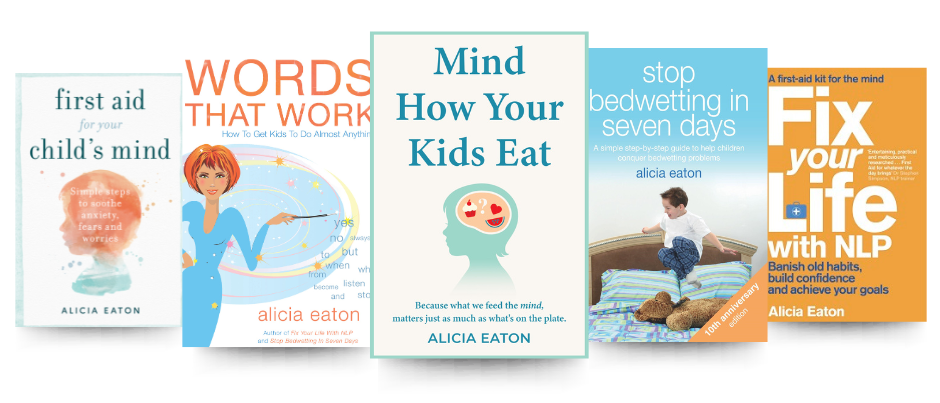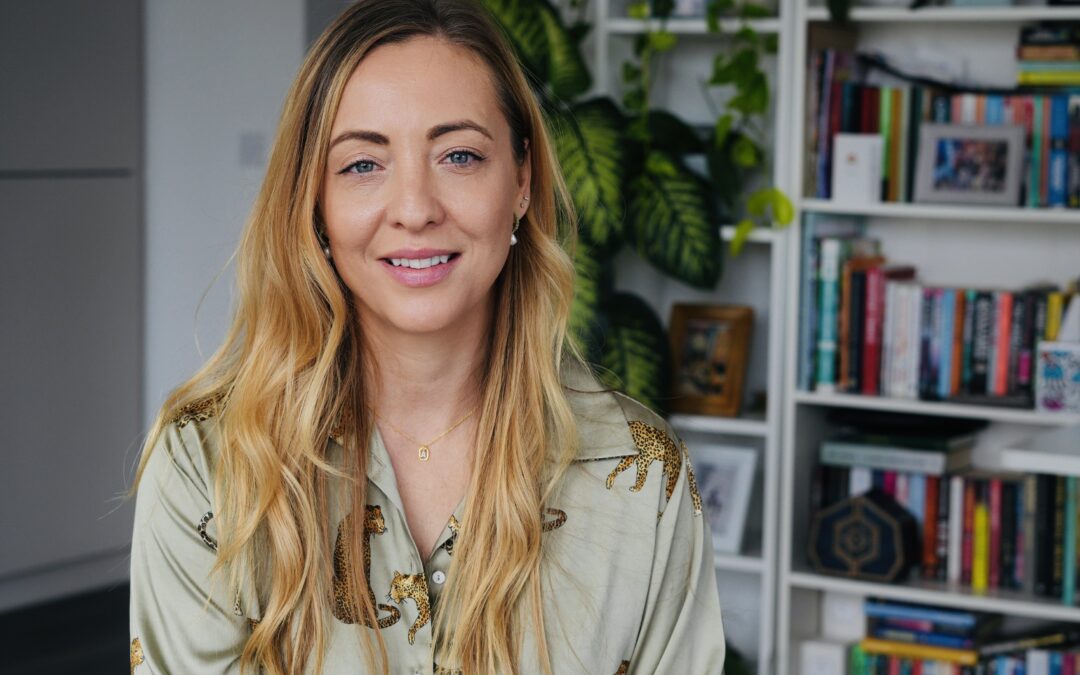
Alicia Eaton’s latest book Mind How Your Kids Eat is a great read. It offers ground-breaking and smart advice to give parents tools for difficult problems. And this is not the first time that Alicia, a mother of three with decades of experience helping families, has written a book that readers are quickly embracing.
In 2015 Alicia published Words That Work, following on her from her success with Stop Bedwetting in 7 days and before that, Fix Your Life with NLP. Her still popular book Words That Work, which also covers subjects such as homework, exam stress and sleep, shows how many ubiquitous adult commands and remarks can be exchanged for what could be called the ‘language of persuasion’ to motivate children and give them calm and confidence.
Alicia seems to have found a calling as an author. With Mind How Your Kids Eat she’s produced a book which is super accessible and seamlessly combines personal anecdotes, knowledge and practical solutions.
Alicia has never wavered from her belief that, “the focus needs to be a child’s development. What the child needs.” She acknowledges that whilst kids are not stupid, they also absorb so much from their parents.
In interview, Alicia says, “Individual problems such as food anxiety, extreme nervousness and separation issues can be fixed.” She also acknowledges how many parents are constantly questioning their actions because we live in a world with “information overwhelm…too much observing of each other’s lives…pressures to be perfect.”
Alicia first became a mother in the late 80s. To meet her today it’s hard to believe that her children are in their thirties because she has such a youthful energy. When all her children were under seven years, Alicia started her own Montessori school in Chorleywood, Hertfordshire. By the time she sold the school five years later, she had 26 pupils and a strong team of teachers.
Passionate about Montessori education, in Mind How Your Kids Eat, Alicia draws on her Montessori training and experience to outline the unique way in which break time and snacks are handled, based on the philosophy that children can be trusted to have the freedom to make their own choices.
Nowadays the challenge that seems to largely preoccupy Alicia is child obesity. After training as a psychotherapist, counsellor and clinical hypnotherapist, she spent seven years working with the world-renowned behavioural scientist Paul McKenna who uses Neuro-Linguistic Programming (NLP) to address such issues as weight loss.
Alicia is concerned about the statistics. According to NHS Digital over one third of children in the UK are overweight or obese by the end of primary school. Alicia writes, “the age of six is a critical tipping point in a child’s weight journey” and that if a child is not shown how to have a healthy relationship with food, then there can be further problems in adulthood.
With a belief in consistent little steps, Alicia concludes, “…the earlier we notice unhelpful patterns – oversized portions, food used for comfort, or a reliance on ultra-processed snacks – then the more time we have to gently nudge things in a better direction.” Diets and restrictions are apparently not the way to go.
Another subject which Alicia Eaton addresses in her book is fussy eating. She went through this challenge herself with one of her children who didn’t, as a hospital psychologist advised her, ‘grow out of it.’ At the time she imagined that her son spent his childhood feeling hungry because his list of acceptable foods was so short.
After several years of battling with her son, Alicia realised, “that for things to change, I had to change first.” Nowadays she advises that fussy kids can benefit from being unpressured, and, guided towards getting up close and intimate with food.
Alicia also writes about the importance of how meals happen and involving children in the preparation of meals. In her own home, she used family mealtimes to check in with her children.
“Most parents are firefighting,” she says, when asked to name a typical issue raised by parents at her Harley Street clinic. “The scheduled family meetings which I recommend are a good way to deflect arguments in the moment and give families the chance to reduce misunderstandings, build trust and connection.” In her latest book, Alicia explains, “these shared conversations create a sense of we’re in this together…children feel more involved and more willing to cooperate.”
With a keen understanding of a child’s perspective, Alicia is determined to give parents peace and make their lives easier. As is her method, in the chapter on food anxiety and sensory sensitivities, Alicia directly engages readers. The book’s reflective questionnaires, uncomplicated exercises and visualisations, and the wish lists for parents, feel fun and logical.
All her solutional lists point to an overriding view that “food is never just about food. It’s about love, safety, identity and belonging.” For example, Alicia writes, “what we eat can change” but how a child eats, “that sticks…because the way we do things – the tone, timing, the togetherness – becomes part of a child’s emotional script.”
The clear and attainable wisdom in Mind How Your Kids Eat, will make this 134-page book a welcome companion in your family home.