Until 1st November, the free Frieze Sculpture exhibition in Regents Park offers a memorable time in nature. The exhibition is between St Andrew’s Gate and Chester Gate on the outer circle, in a lovely part of the park which is not far from the Queen Elizabeth II Garden. This year there’s fifteen installations by twelve artists.
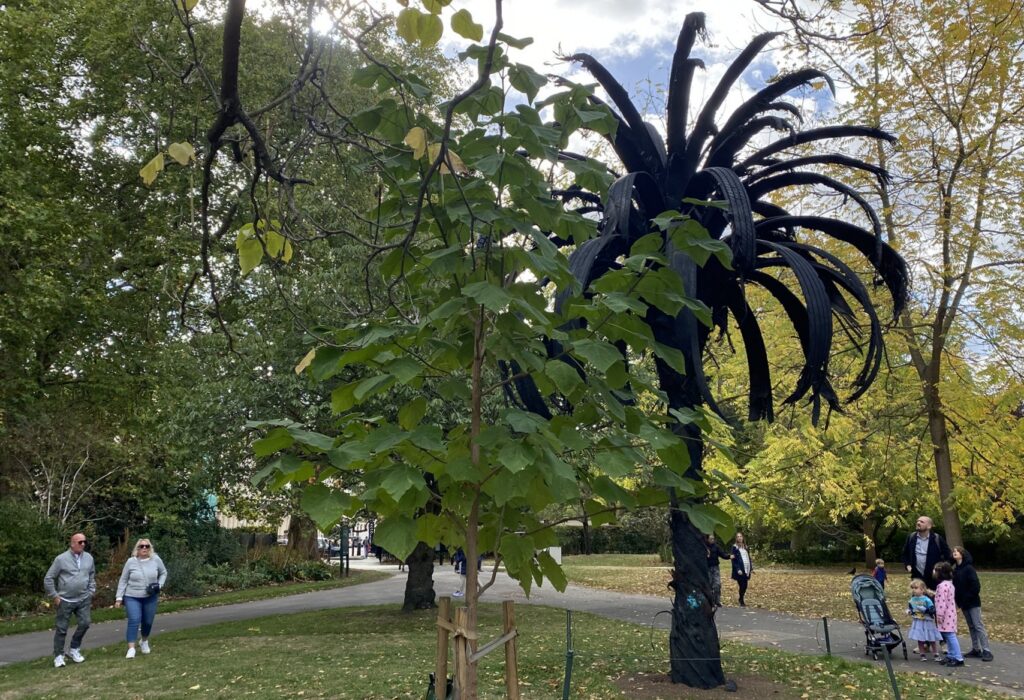
If you can start at St Andrew’s Gate then the first sculpture you’ll see sets the tone for the exhibition, with its’ ingenious combining of different materials. The 7-metre high Black Palm by Douglas White is so realistic with its’ soft, folding fronds that at first you might not notice the leaves are made from fragments of tyres which apparently White sourced from roadsides in Central America.
As the Frieze exhibition has been running for 14 years, you may already know it. But this is a special year because it’s the fourth and last Frieze exhibition put together by the London-based curator Fatos Ustek, who apparently is available for tours if you’re a Frieze member.
On a sunny October morning, I was part of a Friends of Regents Park and Primrose Hill tour. A group of about ten, led by the charming and confident Anne-Marie, who also shared how she met some of the artists in September, just before the exhibition opened, and when the great labour of erecting the sculptures took place.
Three of The Virtues and Vices of our Times sculptures by Czech artist Matyas Chochola have been ‘planted’ in the park and fit super well in the natural environment. We were told that Chochola makes his materials using vast state of the art 3D printers and then assembles and adorns his sculptures by hand. Our group consensus was a resounding – fascinating!
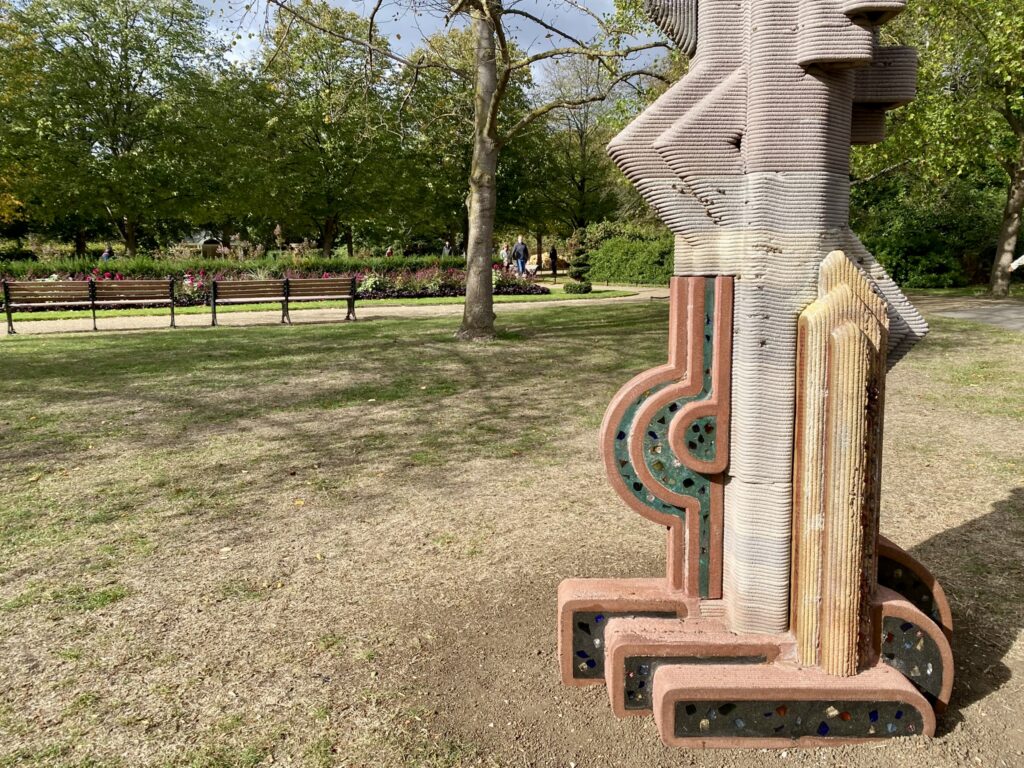
Part of MACE II by Matyas Chochola
You don’t need to be on a tour to enjoy the sculptures. Especially as the exhibit labels are well-written. And in Possibilities for a Sculpture artists Ozlem Gunyol and Mustafa Kunt provide interactive fun for adults and children. Across the exhibition they’ve installed three ground level plinths with instructional texts so that viewers can reconstruct the absent statues; and the exhibit labels will tell you which London statues you’re recreating.
Also when I was at the park, Bloomberg Connects, the official digital guide, had a couple of friendly people giving out complimentary kids packs which I saw several children using with great glee!
For this review, I’m purposefully not showing full photos of the sculptures so that if you’re planning to go to the exhibition without looking at it initially online, it’ll be the first time that you’re seeing them in their entirety. Many of the sculptures have been created to surprise viewers, or suddenly look altogether different when the sun shines on them. Sri Lankan-born Ramesh Mario Nithiyendran’s Warrior Figure with the sculpture’s two faces is a good example of how the Frieze sculptures offer more than meets a first glance.
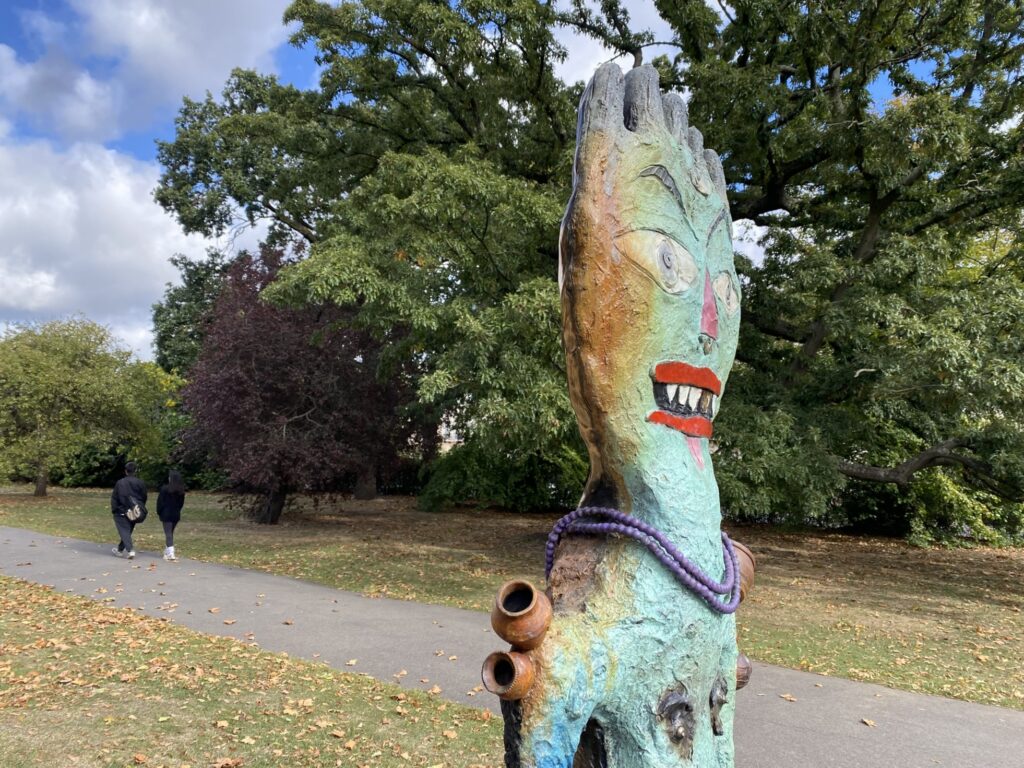
Nithiyendran’s bronze Warrior Figure was originally hand-built in wet clay and cast through the ancient lost wax process.
If our group were forced to name a couple of favourites, one would likely be The Sun Bathes Its Friends and Neighbours by Tarini Sethi. Discovering the Indian sacred imagery weaved into four interconnecting panels or doors, we met other park people who also felt inspired to share the feelings that this sculpture evokes.
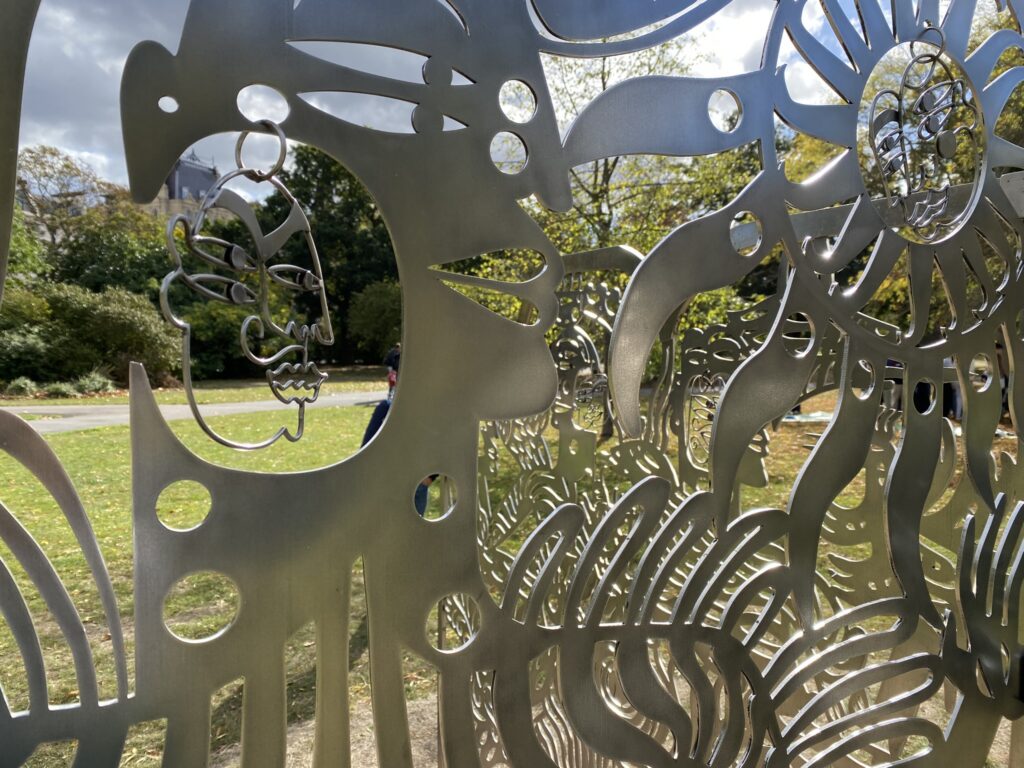
As Anne-Marie said, “Hanging faces which dingle and dangle add beautiful contrast to the stainless steel panels in The Sun Bathes Its Friends and Neighbours.”
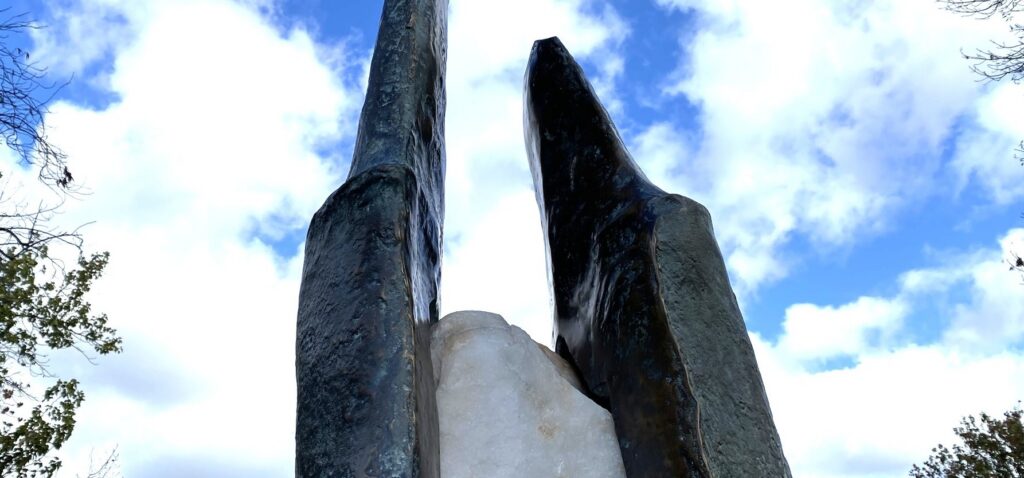
Our group also had an immediate emotional connection with the dynamic Held by Carolina Aguirre. Back home, I was inspired to listen to Aguirre in a two-minute video which she made for Frieze (also available on YouTube). She speaks of, “two bronze halves holding the rock very tenderly” – the rock being a white quartz, sourced from her family home in Uruguay. When you go up close, the “smoother, warmer toned” interior exposes “inscriptions and scars” etched into the bronze. Aguirre also eloquently speaks about her intention to portray, “How you hold home at a distance within yourself. How you carry memories of somewhere…how we hold on to that sense of identity.”
Thank you Friends of Regents Park & Primrose Hill for a wonderful couple of hours!
The Frieze Sculpture Exhibition from 16 September until 1 November 2026 is located in the English Gardens at the south end of The Broadwalk, at St Andrew’s Gate entrance.
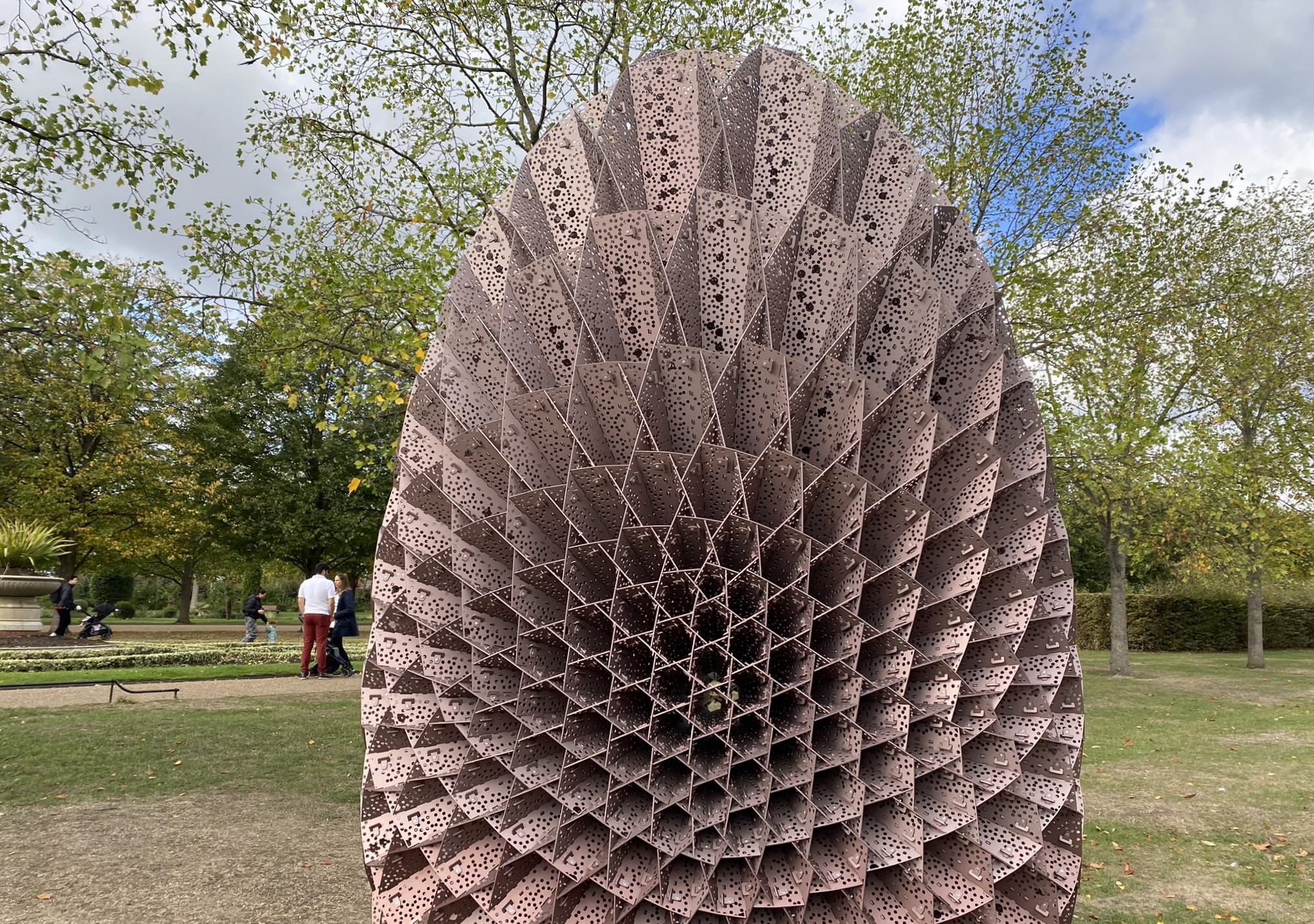
Cover Photo: Part of Eye of the Needle by Conrad Shawcross. Perhaps one of the most popular sculptures because of how long park people spent exploring this elliptical monolith. Made from perforated anodized aluminium, it invites you to look through it and many of our group were enchanted because for them it stirred childhood memories.