I recently visited one of two National Trust houses close to Belsize Park. From 1937-1939 Hungarian-British architect Ernö Goldfinger built his family home at 2 Willow Road and lived there until his death in 1987, aged 85.
Ernö Goldfinger was an early adopter of modernist architecture, believing in functionality over form. He is remembered for having designed the 27-storey Balfron Tower in Tower Hamlets, the Grade II listed residential development Metro Central Heights in Southwark and Trellick Tower in West London, where he stayed for two months to be able to experience his 31-storey residential creation.
Goldfinger’s children, Peter, Liz and Michael, gave the Treasury their parents’ house at 2 Willow Road in lieu of tax owed and thereafter, 30 years ago, the National Trust opened it to the public.
From March to October on Thursday and Saturday afternoons between 3pm-4.30pm, it’s possible to book a visit to the house. On those days there are also four guided tours between 11am-2pm.
I was glad to have booked a tour because it was fascinating to learn about Goldfinger’s architectural approach, and the furniture, most of which he designed.
The Exterior
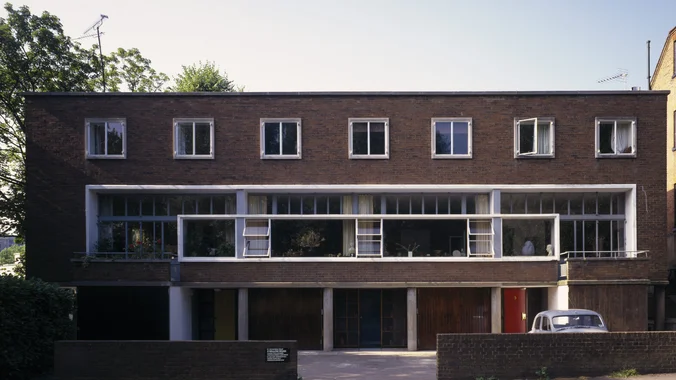
What is now 2 Willow Road was originally built as three terraced houses. Ernö, his wife Ursula Blackwell and their children lived in the middle house over four floors. In the late 1930s, Hampstead was all Victorian and Georgian houses so that Goldfinger was ahead of his time with his brutalist ambitions, such as reinforced concrete frames and pillars to support the house and a flat, not pitched, roof.
The Guided Tour
As our group of about ten people were led through the interior by the fluent and engaging tour guide Geoff, I marvelled at how Goldfinger maximised space and valued practicality. On the light and high-ceilinged first floor, the dining room table is not made of wood as traditional to that era, and instead of internal structural walls, Ernö used partitions between rooms.
There were books and clever bookshelves everywhere. It reminded me that pre and post war people didn’t have many possessions and mostly it was books. The sparseness of the main and guest bedrooms reflect this. In contrast Ernö and Ursula’s offices are filled with curious objects.
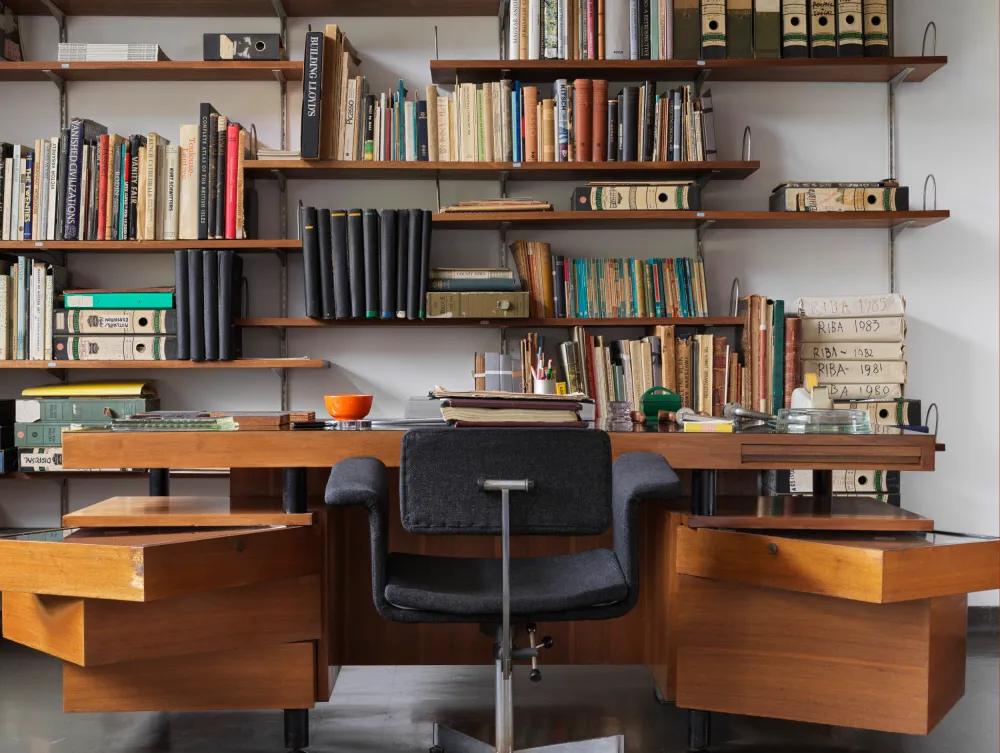
After Ernö retired and moved out of his Piccadilly offices, he moved his desk to his home and placed it in the room which had been Ursula’s studio.
I don’t want to reveal too much about what I saw and learnt so that you too might experience the many surprises. However, I must share this one story. Our guide Geoff told us that for his 1959 novel Goldfinger, Ian Fleming called his villain Auric Goldfinger after Ernö. Apparently, Fleming was a keen golfer and one day he was playing golf with Ursula’s cousin, when he heard of the name Goldfinger and wanted to use it in his book. Ernö was most definitely not happy about this!
Even now, over 70 years later, I’d be happy to live at 2 Willow Road; although for people who loved entertaining, I can’t understand how the Goldfingers managed with such a small kitchen!
Both Ernö and his wife loved art – Ursula had studied painting in Paris – and the house is filled with treasures from emerging artists from the 30s to the 70s, including Eduardo Pailozzi, Fernand Léger, Joan Miró, Henry Moore and Man Ray. Purist art, abstract, figurative, kinetic art – they had a broad appreciation. And I am sure a tour of 2 Willow Road will give you an appreciation for the great Ernö Goldfinger.
If you are a National Trust member, you can enter for free. Otherwise, it’s normally £13.
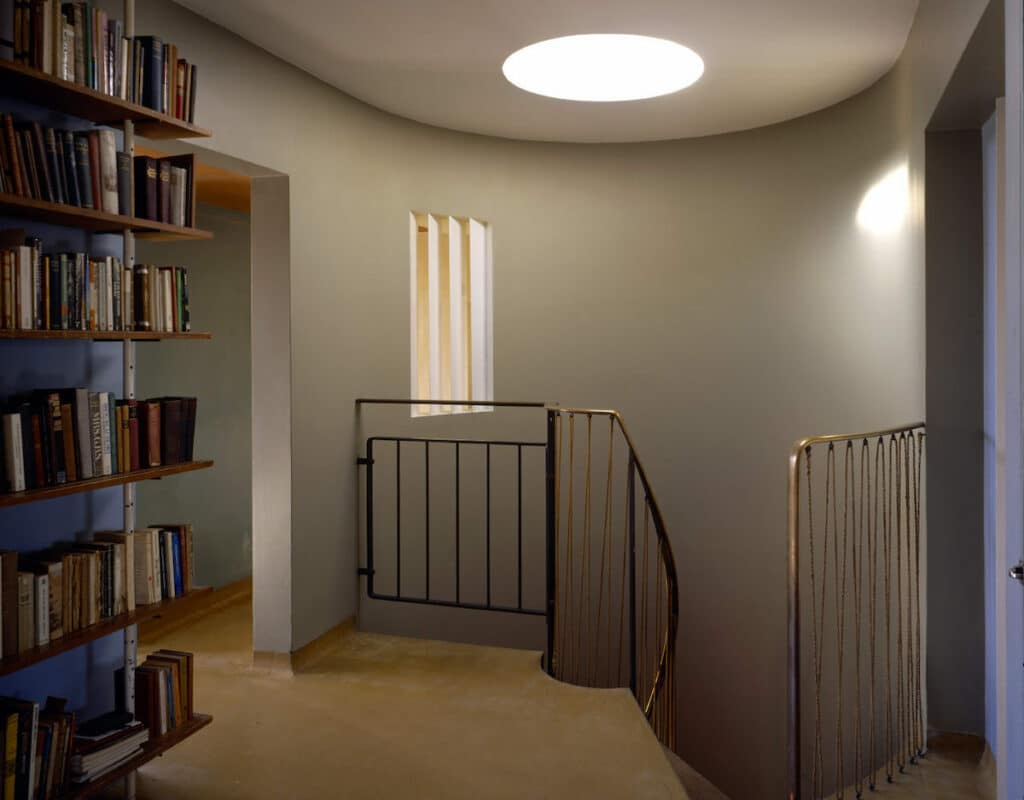
Cover Photo: Goldfinger designed an elegant spiral staircase to run through the centre of the house.
All photos courtesy of The National Trust at 2 Willow Road.